Financial services still make many decisions using a picture of customers that can be incomplete, historic, or built around lives that no longer look typical.
Richer data can help firms see affordability more clearly. The harder question is whether the decision, and the route forward when the answer is no, make sense to the person affected.
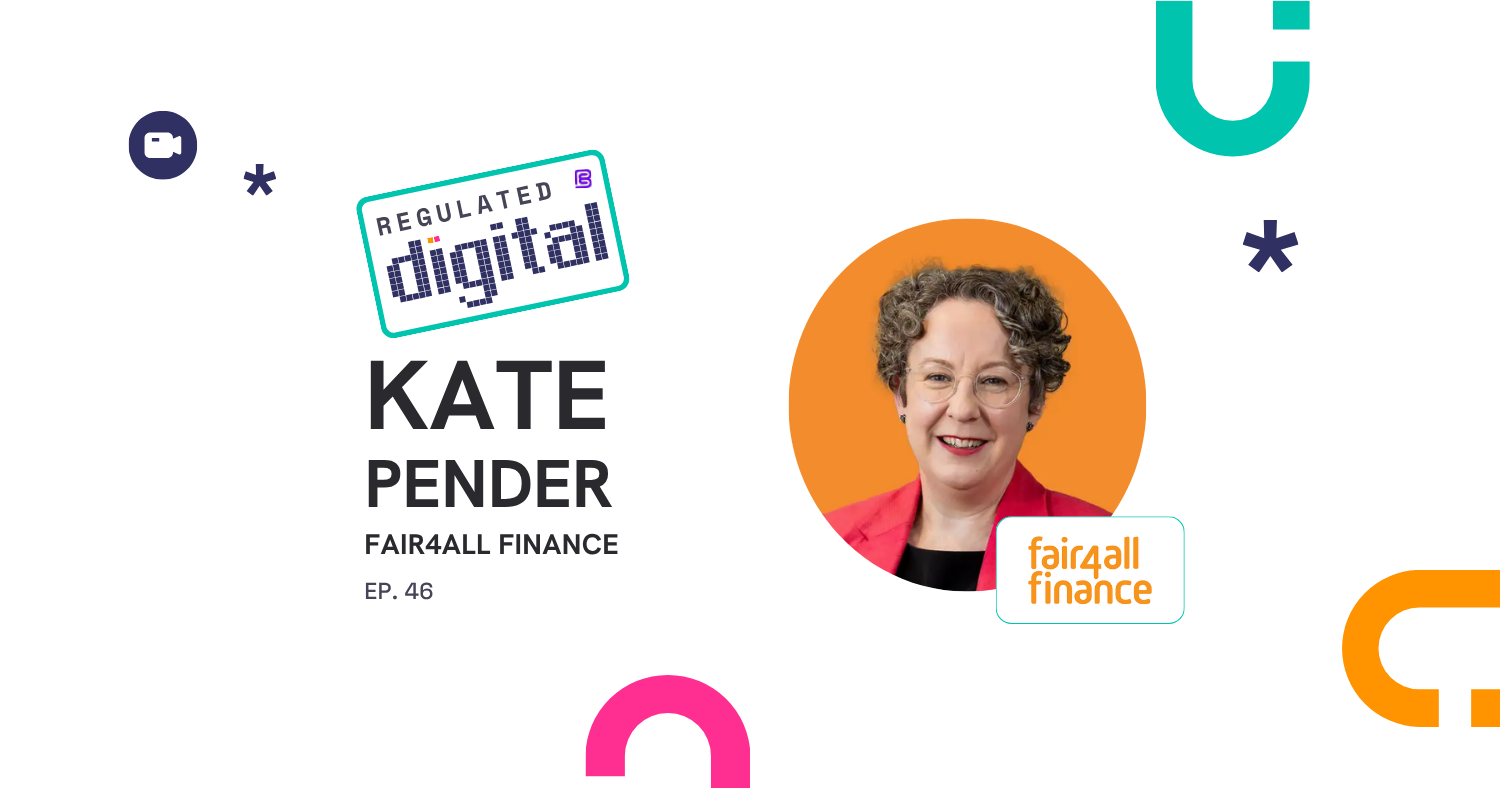
On Regulated Digital, Kate Pender, CEO of Fair4All Finance, joined us to explore what happens when financial-services firms use open banking, richer customer data, and AI to make decisions about access to credit.
Better information can reveal income patterns and repayment capacity that a conventional credit file misses. It can also create new risks when customers do not understand why data is being requested, how an automated decision was reached, or what they can do when the process declines them.
Watch the full episode above, or listen on Apple or Spotify podcasts.
Written from the episode transcript with the help of AI, then edited and checked by our team.
When The Data No Longer Matches The Customer
Fair4All Finance's latest work puts the scale of the problem at more than 20 million people with low financial resilience.
Its 2026 affordable-credit work also estimates a £2 billion gap in credit that could be supplied on a commercially viable basis to people who are currently poorly served by mainstream providers.
A credit file can be particularly limiting when someone's circumstances do not fit the assumptions built into traditional lending.
Young adults may have little borrowing history. Someone who has recently moved to the UK can have a good income and stable employment while remaining almost invisible to domestic credit records.
A historic default or county court judgment can continue influencing decisions long after the circumstances behind it have changed.
"The system is just not working for an extraordinarily large number of people."
The underlying issue is the difference between what the data records and what a lender needs to know.
The FCA's Credit Information Market Study examined the quality and completeness of credit information and how weaknesses in the market can affect lending decisions.
A fuller record creates the possibility of judging someone's current position rather than treating a limited or imperfect file as the whole story.
Richer Data Can Produce A Better Affordability Picture
Open banking gives lenders access, with consent, to transaction information that can show income, regular expenditure, existing repayments, and changes over time.
That can be particularly useful where income is variable but still predictable over a longer period.
Salad Money provides one example. Its Credit Where It's Due analysis compared credit-reference data with 50,000 loan records.
It found that 35% of both accepted and declined applicants had an insolvency or county court judgment, while more than 10% of customers did not have a credit score. Customers without a score performed no worse than Salad's typical customer.
A credit file records one part of somebody's financial history. Transaction data can add a current view of income, expenditure, rent, repayments, and other financial behaviour that may not be visible in that file.
Kate described a borrower whose monthly income looked volatile when viewed over a short period.
Looking across a longer stretch of open-banking data showed a pattern that was much more regular, giving the lender enough confidence in her capacity to repay a small loan.
The funding then allowed her to take a job in another town and absorb the higher commuting costs before her new income arrived.
Better Data Can Change The Product A Customer Is Offered
Richer information becomes more useful when it changes the design of the customer outcome as well as the risk score.
Fair4All Finance's published case study of Leanne shows the difference. She initially applied to her credit union for £500, but an open-banking review found very little disposable income and several expensive existing loans. Adding another £500 of borrowing would have left the underlying problem untouched.
The credit union instead arranged a £2,000 no-interest consolidation loan over 24 months. It brought the existing debts together and reduced her monthly repayments from £346 to £83.33.
Stage
What The Data Showed
Outcome
Initial application
Request for a £500 loan
Existing criteria would not support the loan
Richer assessment
Low disposable income and expensive existing debt
A consolidation loan addressed the underlying problem
This broadens the role of decisioning. Instead of stopping at whether the customer qualifies for the product they selected, a firm can use the information to identify a more suitable route through the same problem.
Customers Need A Reason To Share More Data
That richer view depends on customers agreeing to provide information. Consent becomes harder when a customer sees an expanding list of data requests without understanding what each one will do for them.
Kate described a Fair4All Finance pilot where providers collected unusually detailed information about customers' personal characteristics so the organisation could measure who the scheme was reaching.
Despite expectations that many borrowers would decline to answer, 93% provided the information. Kate's interpretation was straightforward: people were told why the information was being requested and what Fair4All Finance wanted to learn from it.
Data Can Also Surface Support
Policy in Practice estimates that £24.1 billion in income-related benefits and social tariffs will go unclaimed across Great Britain in 2025/26.
Kate pointed to benefits calculators as an example of using customer information for something beyond screening.
Information gathered during a financial journey can help identify support a customer may be entitled to but does not know about. That gives the customer a clearer reason for providing data because there is a visible purpose beyond deciding whether to reject them.
Explainability Has To Work For The Customer
A technically sophisticated model can still end in a very basic customer experience: application declined. For somebody using the service, explainability starts with knowing why and what happens next.
"The models that are being used to make these decisions are really opaque to the consumer."
Kate gave the example of a young care leaver who had saved enough for a second-hand car so he could accept a promotion, but could not afford the insurance quote.
A more experienced named driver could legitimately have reduced the premium, yet nothing in the journey explained that possibility. He saw the price, concluded the job was no longer viable, and turned the promotion down.
The example shows why an automated decision needs a route beyond the result screen.
Customers may need to correct inaccurate data, provide context the model cannot see, explore another product, or speak to somebody who can explain the options available. A decline without a useful next step can turn a model limitation into a customer outcome.
From Mailock
Communicating Sensitive Financial Decisions By Email?
Learn how Mailock helps financial services firms protect sensitive messages, verify recipients, support secure replies, and track delivery.
For firms, that means customer communication has to be designed alongside decisioning. The wording, security, data requests, escalation route, and evidence around a sensitive decision all form part of the same operational process.
Four Practical Changes Firms Can Make Now
Kate's recommendations for financial-services leaders were grounded in changes that can already be made, rather than waiting for open finance or another generation of AI models.
Use richer data where it improves the picture. Open banking can help firms understand current income, expenditure, liabilities, and financial patterns that a conventional score can miss.
Review hardwired decline rules. Firms can test whether markers such as historic CCJs or previous use of higher-cost credit still predict the outcome they are being used to predict.
Design alternative product routes. A customer applying for additional borrowing may be better served by restructuring or consolidating existing debt.
Make the back office capable of delivering the alternative. Technology such as Experian's ReFi allows lenders and customers to settle existing debts directly with creditors as part of a consolidation journey, reducing the risk of existing and replacement borrowing being counted together in the affordability assessment.
Those changes require decisioning, customer communication, and operational systems to work together.
A model can identify an alternative outcome, but the firm still needs a process capable of explaining and delivering it.
Commenting for this article
"When a firm asks someone for more personal data, the customer needs to understand why it is being requested, what decision it informs, and what happens if the automated route does not work for them. That explanation has to be designed into the customer journey."
Paul Holland, Founder and CEO, Beyond Encryption (Mailock)
Richer data gives firms more ways to understand customers whose circumstances do not fit conventional credit rules.
The question is whether that fuller picture leads to a useful decision, an understandable explanation, and a route forward when the original product is not the right fit.
FAQs
What Is A Thin Credit File?
A thin credit file contains limited information about a person's borrowing and repayment history. It can affect young people, people who have recently moved to the UK, or anyone who has made limited use of credit, even where their current finances are stable.
How Can Open Banking Support Fairer Lending Decisions?
With the customer's consent, open banking can show current transaction information including income, expenditure, and repayments. This can give a lender more context about affordability and financial patterns than a credit score alone.
What Does Explainable AI Mean For A Financial-Services Customer?
For the customer, explainability means receiving an understandable reason for a material decision and knowing what they can do next. That might include correcting information, providing additional context, considering another product, or asking for human support.
Where Should Human Judgement Remain In Automated Financial Decisions?
Human support is particularly useful where data may be incomplete, circumstances fall outside standard patterns, a customer wants to challenge a decision, or there is a legitimate alternative that an automated journey has not surfaced.
Sam Kendall works on digital marketing for Mailock by Beyond Encryption, helping build B2B marketing activity around research, first principles, and sustainable growth. He writes about marketing effectiveness, positioning, customer communications, and digital culture, with longer-form work published at ATNL.net.
 Sam Kendall


.svg)
 Previous post